Shopify Fuzzy Search: Fix Misses Before You Add an App
Learn why Shopify's fuzzy search misses products, how to fix issues without code, which developer settings help, and when a managed service fits.

Shopify Fuzzy Search: Fix Misses Before You Add an App
Shopify’s built-in search tolerates small typos, but only when the first four characters of the term are correct, as Shopify’s search behavior documentation explains. Predictive search and Search & Discovery add smarter matching, yet search syntax can switch those features off. If you keep seeing zero-results pages, the checklist below fixes most of the causes.
TL;DR:
- Shopify matches a one letter error or swapped letters only when the first four characters are correct; quotes and field modifiers disable that tolerance.
- Enable predictive search in a compatible theme, test misspellings on phones and laptops, and remember that Storefront API searches return at most 1,000 results.
- Use Search & Discovery analytics to prioritize frequent queries that return no results, add synonyms or boosts only for valuable terms, and review misses weekly.
- For partial word matches, developers can use the search prefix option on the final term; sending plain text preserves fuzzy matching.
Table of Contents
- How does Shopify’s built-in typo tolerance work?
- When do Shopify’s fuzzy and semantic features switch off?
- How does predictive search handle misspellings as customers type?
- What can you fix today without writing code?
- Which developer options control partial matches and type-ahead?
- What problems do merchants report, and how do you diagnose them?
- How does Indexa fix search misses for you?
- Should you fix search natively or move to a managed service?
- FAQ
- Sources
How does Shopify’s built-in typo tolerance work?
Shopify’s native typo tolerance is narrow by design. It finds terms that differ by one letter or have two letters swapped, and it only kicks in when the first four characters you type are right. So “snowboard” can still find a snowboard, while “nowboard” cannot.
A few details to test first:
- Searchable fields: product title, variant title and description are the main fields searched by default, per the predictive search documentation.
- Partial words: a half-typed word does not match a full one unless the search uses the prefix option (covered in the developer section below).
- Synonyms: Shopify advises against adding common misspellings as synonyms, because typo tolerance already covers them.
- Maintenance: large manual lists can create maintenance debt and conflict with the native AI models.
Spend some time testing your best sellers with a typo. That tells you more than any settings page.
When do Shopify’s fuzzy and semantic features switch off?
Typo tolerance is not guaranteed on every query. According to Shopify, semantic understanding, predictive search and typo tolerance are all disabled when a query uses search syntax such as quotes or field modifiers. Developers who build syntax-heavy filters can strip out the intelligence without noticing. Watch for these situations:
- Syntax in the query: quotes,
field:modifiers and boolean groups follow the shared search query grammar and are treated as exact instructions, not fuzzy ones. - Another engine in charge: a third-party search app or custom theme code may override Shopify’s predictive and fuzzy behavior, so confirm which component serves your storefront search.
- Result ceilings: predictive search results are limited by default, and the Storefront API returns up to 1,000 results, so a valid match can still fail to surface.
If a typo works in one place and fails in another, suspect the syntax or the search engine behind that page before blaming Shopify.
How does predictive search handle misspellings as customers type?
Predictive search suggests products, collections, pages and query terms while a shopper types, so many typos get corrected before anyone presses Enter. This matters because autocomplete is where misspellings do the most damage. Baymard Institute’s search research finds that many sites fail to map misspellings into useful suggestions, and that fixing this reduces abandonment.
- Check the theme: predictive search needs a compatible theme or the Predictive Search API, and the Predictive Search setup guide covers the testing steps.
- Test real typos: try common misspellings and brand-name variants on a phone and a laptop.
- Tune the limits: if your theme supports it, adjust the number of suggestions and the searchable fields.
- Watch the flow: Baymard’s autocomplete article notes that suggestions for misspellings spare shoppers from retyping their queries.
Pro Tip: Search your own brand name with one letter wrong. Brand variants are the typo your most loyal customers are most likely to make.
What can you fix today without writing code?
Work through this list in one sitting, in order:
- Confirm predictive search is on and visible in your theme, then test misspellings on the live storefront.
- Open Search & Discovery analytics, find your top no-results queries, and add synonyms or boosts only for high-value terms.
- Set the out-of-stock and combined-listing options so availability does not hide relevant products.
- Build a short product-boost list for your highest-converting queries instead of boosting everything.
- Review zero-results queries weekly and fix the ones with the most search volume first. Our search audit checklist helps you triage.
Shopify’s Search & Discovery guidance supports each of these controls. Short, targeted lists beat exhaustive ones.
Pro Tip: Sort no-results queries by how often shoppers type them, not by how odd they look. Frequent misses can matter more than rare ones.

Which developer options control partial matches and type-ahead?
Developers can build custom type-ahead without losing Shopify’s typo tolerance, as long as the query stays clean. The Storefront API search and discovery guide describes semantic search and search analytics as ways to move beyond plain keyword matching.
- predictiveSearch: the predictiveSearch query returns suggestions as customers type and can filter by resource type and searchable fields.
- Prefix argument: the search query’s prefix option matches partial words on the last term, so “snowbo” can reach “snowboard”.
- Plain queries: pass shopper text as typed. Wrapping it in field-scoped syntax turns the fuzzy layer off.
- Debouncing: the theme predictive search guide recommends debouncing input so you do not fire a request on every keystroke.
- Tracking: send search analytics events so the platform can learn from clicks over time.
Test with deliberately misspelled input before shipping any custom component.
What problems do merchants report, and how do you diagnose them?
Community threads show the same failure modes repeatedly: stores losing results after an update, shoppers hitting empty pages, and POS lookups behaving differently from the storefront. One merchant thread describes a POS update that added fuzzy behavior and disrupted product lookup at checkout. Another asks about exact versus fuzzy matching in API queries.
- POS lookups: test them separately from the storefront, and check whether a theme or app update changed the endpoints.
- Zero results: check searchable fields, publish status and out-of-stock handling. Stop words can also cause misses.
- Mismatched results: if the storefront, admin and API disagree, verify whether native search or an app is serving each one, then roll back or adjust.
How does Indexa fix search misses for you?
If you have already tuned Search & Discovery and still see missed searches, we run the fix for you. Our managed AI search and discovery service adds typo-tolerant and semantic search to your Shopify store, with visual merchandising and ongoing tuning handled by our team, so you keep your time.
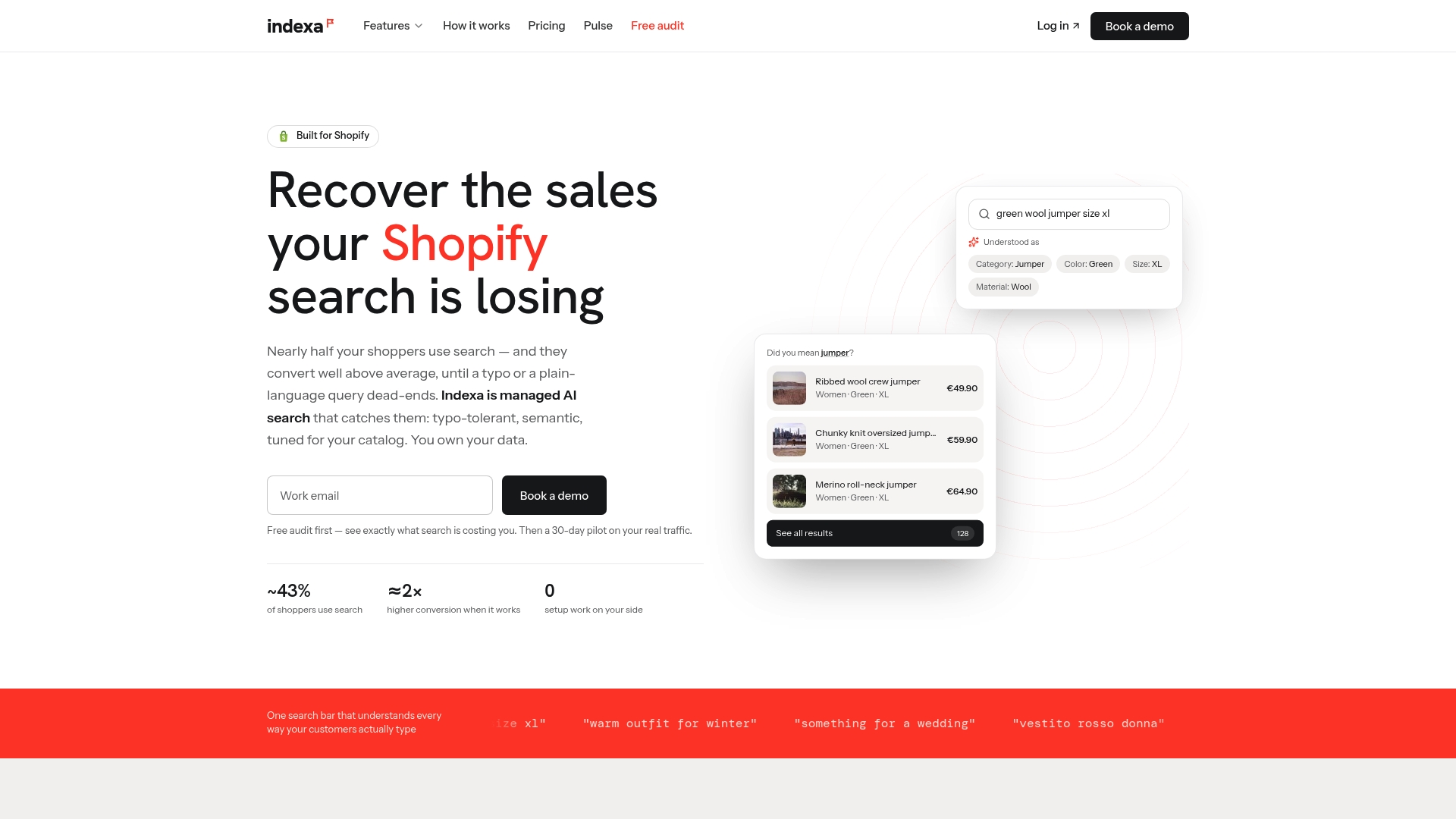
The lowest-risk first step is our free audit, which helps you assess your store’s search. From there, you can learn more about our service. Details are on our pricing page. Request the audit today and see which misses we can win back.
Should you fix search natively or move to a managed service?
Native search plus Search & Discovery is enough for many stores. If your catalog is simple and your no-results list is short, tune it and move on. If zero-results keep piling up, brand names get misspelled in creative ways, or you need steady tuning across languages and categories, a managed service removes the upkeep. Run the audit checklist first, then decide with real numbers.
— Barikreativa
FAQ
Does Shopify have fuzzy search built in?
Yes. Shopify includes native typo tolerance that matches terms differing by one letter or with two letters swapped. It only applies when the first four characters are typed correctly, per the search behavior documentation.
How do you enable fuzzy search on Shopify?
There is no switch for it, because typo tolerance is on by default. Make sure predictive search is active in your theme and that your queries avoid search syntax such as quotes or field modifiers, which disable fuzzy behavior.
Should you add common misspellings as synonyms?
Usually not. Shopify advises against it because built-in typo tolerance covers common errors, and large synonym lists can interfere with the native algorithm. Reserve synonyms for real vocabulary gaps, like a shopper’s term for a product you name differently.
Why do misspelled searches still return no results?
The usual causes are a typo in the first four characters, search syntax disabling fuzzy matching, or a third-party app serving results. Check which engine powers your search before changing settings.
Do better search tools help with SEO?
Search and discovery sit alongside visibility work, since both help shoppers find products. For the visibility side, this ecommerce AI SEO playbook offers broader context.
Sources
- Shopify Help Center | Search behavior in your online store
- search
- Shopify Help Center | Predictive search
- Shopify Help Center | Modifying search with Shopify Search & Discovery
- E-Commerce Search Usability Research Studies – Baymard
Recommended
Make discovery work harder.
See what your Shopify search could do better with a free, hands-on audit.
Get your free search audit