Ecommerce Synonym Strategy: Fix Zero Results Without Hurting Relevance
Prioritize zero result searches, use directional synonym rules, and test changes with people before rollout to protect relevance in Shopify product search.

Ecommerce Synonym Strategy: Fix Zero Results Without Hurting Relevance
A focused synonym strategy reduces zero-result searches and recovers conversions you are otherwise losing at the search bar. Shopify’s search and discovery system already applies automatic synonyms for common vocabulary, but gaps remain where human-reviewed rules still matter. Start by exporting your search logs and ranking the queries that return nothing against how often shoppers type them.
TL;DR:
- Export search logs, rank failed queries by frequency, verify matching products exist, and prioritize the top 10 before adding synonym rules.
- Shopify automatically matches common terms such as sweatshirt, hoodie, and pullover; reserve custom rules for gaps that native matching demonstrably misses.
- Use two way mappings only for true equivalents; keep directional or related mappings narrow, and validate candidates before launch.
- Review automated long tail matches, preview each mapping, and pilot changes before expanding through a 30 to 90 day review cycle.
- Track zero result and reformulation rates, click through rates, add to cart activity, and search session conversions against a baseline for affected queries.
Table of Contents
- Why synonyms matter for ecommerce site search and revenue
- Synonym types with concrete ecommerce examples
- How to discover and prioritize synonym candidates from your store data
- Implementation approaches: manual rules, automation, and document enhancement
- Governance and safe rollout: testing, human validation, and monitoring
- Measuring impact and attributing revenue to synonym work
- What merchants consistently get wrong about synonyms
- Where a managed search service fits into your synonym strategy
- FAQ
- Sources
- Primary sources and further reading
Why synonyms matter for ecommerce site search and revenue
Shoppers rarely use your catalog language. Someone searching “sneakers” should find products you tagged “trainers,” and someone typing “couch” should land on what your team filed as “sofa.” Every mismatch between shopper vocabulary and product text is a potential dead end, and dead ends cost sales.
Search quality is a balancing act. Widen recall too aggressively and you return irrelevant products, eroding trust in the search bar itself. The hardest cases tend to cluster in predictable places:
- Long-tail queries that combine a feature, brand, and use case in ways your catalog text never anticipated.
- Abbreviations and symbols, like “13in” instead of “13 inch,” that fail exact-match logic.
- Regional or generational vocabulary differences for the same product category.
Getting this right is less about adding more rules and more about fixing the ones that affect real traffic.
Synonym types with concrete ecommerce examples
Not every synonym behaves the same way, and treating them identically is how precision problems start. SIGIR e-commerce research on query rewriting recommends directional mappings whenever the relationship between two terms is not symmetric.
- Equivalent synonyms: “bike” and “bicycle” mean the same thing in either direction, so a two-way mapping is safe.
- Directional mappings: “lime” should often expand to “green,” but “green” should not always expand to “lime,” since that narrows results shoppers did not ask for.
- Related or feature mappings: connecting “waterproof” to “rain jacket” can help discovery, but loose associations like this carry the highest risk of semantic drift if left unchecked.
- Abbreviations and symbols: “13in” and “13 inch” refer to the same spec, and Baymard’s testing found these variants are a frequent source of missed matches, especially with inconsistent spacing or hyphens.
Mapping types correctly up front saves you from unwinding bad rules later.
How to discover and prioritize synonym candidates from your store data
Guessing at synonyms wastes effort. The reliable approach starts with your own search logs, not assumptions about what shoppers might type.
- Export internal search logs and isolate queries with zero results or frequent reformulation.
- Rank those queries by frequency, since high-volume failures affect more shoppers per fix.
- Cross-check each candidate against your catalog to confirm the product actually exists before you build a mapping.
- Score remaining candidates using behavioral signals like click-through and add-to-cart rates on similar queries that do return results.
This sequence matches the workflow Baymard recommends for no-results pages: confirm inventory exists, then classify the relationship between the query and the product before writing any rule.
Pro Tip: Fix your highest-volume zero-result queries before touching anything else; those queries can account for a disproportionate share of lost search sessions.
Implementation approaches: manual rules, automation, and document enhancement
Three routes exist for closing vocabulary gaps, and most stores end up using a mix, as explained in ecommerce SEO strategies.
- Manual dictionaries give you precise control, which makes them the right tool for brand names, internal SKUs, and store-specific terms that no automated system would ever learn on its own. The tradeoff is ongoing maintenance as your catalog changes.
- Automated extraction and query rewriting scales to long-tail queries a manual list could never cover, but recent retrieval research on long-tail ecommerce queries stresses that synthetic or automatically generated query-product pairs need human validation or a classifier threshold to avoid introducing noisy, low-precision matches.
- Document enhancement adds shopper vocabulary directly into product titles, descriptions, or tags, which avoids runtime rewriting entirely and keeps the original query intact for ranking purposes.
Shopify’s automatic synonym matching can turn a search for “sweatshirt” into results titled “hoodie” or “pullover” without any merchant configuration, according to Shopify’s documentation, which means native behavior already covers a meaningful share of common vocabulary gaps. The practical move is to lean on that native layer first and reserve custom rules for the gaps it demonstrably misses, a distinction we break down further in our guide to fixing synonym collisions.
Governance and safe rollout: testing, human validation, and monitoring
Adding synonyms without a review process is how precision quietly degrades. A practitioner workflow keeps expansion controlled:
- Propose a candidate synonym based on log data, not intuition.
- Classify it as equivalent, directional, or related, since each type carries different risk.
- Preview affected queries before the mapping goes live, to catch unintended matches.
- Run a shadow test or A/B comparison against current behavior.
- Monitor results after rollout and roll back anything that underperforms.
SIGIR research on synonym extraction found that human relevance labels or a classifier filter meaningfully protect precision compared to deploying every candidate synonym automatically. Multilingual stores face an added layer of risk here, since a mapping that works in one market can misfire in another, a problem we cover in our piece on multilingual synonyms breaking for merchants.
Pro Tip: Treat every new synonym as a hypothesis, not a fix, until the metrics confirm it.

Measuring impact and attributing revenue to synonym work
A synonym change is only proven once you can tie it to behavior, not just intuition about relevance.
- Track zero-result rate and reformulation rate before and after each change.
- Watch click-through rate on search results pages for the affected queries specifically.
- Measure add-to-cart and conversion rate from search sessions, not site-wide averages.
- Use a representative query sample with event-level logging so you can trace a specific mapping to a specific outcome.
Short A/B tests or shadow evaluations, where the new mapping runs silently alongside the old behavior, give you cleaner attribution than a full rollout you can only judge in hindsight. Our breakdown of measuring and fixing Shopify search conversion rate walks through setting up that kind of test.
What merchants consistently get wrong about synonyms

Most merchants treat synonyms as a one-time list to build and forget, when the real work is the review cycle around it. The stores that struggle are usually the ones that added every plausible synonym at once, without checking whether a product existed or watching what happened to precision afterward.
A 30 to 90 day checklist works better than a big-bang rollout: audit your zero-result queries first, fix the top 10 by volume, preview every mapping before it goes live, then run a small pilot before expanding further. Conservative, measured changes beat broad automation every time precision is on the line.
— Barikreativa
Where a managed search service fits into your synonym strategy
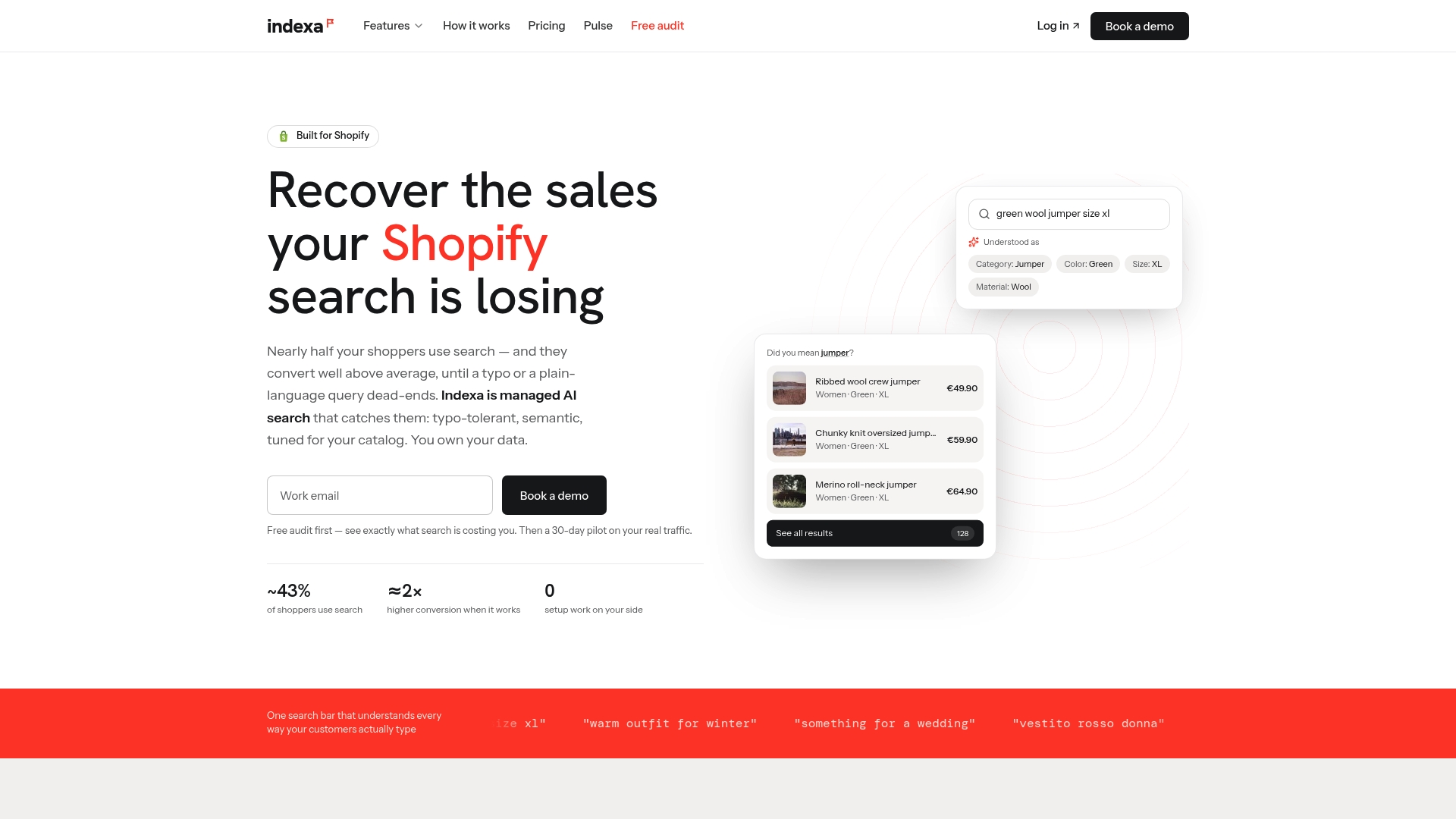
If your team does not have the time or the query-analysis tooling to run this process in-house, a managed approach can get you there faster without the manual overhead. We built Indexa as a fully managed AI search and discovery service for Shopify stores, handling typo-tolerant and semantic search alongside synonym mapping, so the governance work described above runs continuously instead of sitting on someone’s backlog.
We offer a few low-friction ways to start:
- A free audit of your store’s search behavior.
- A pilot so you can see the impact before committing to anything longer.
- Ongoing tuning built into our retainer, so mappings get monitored and adjusted as your catalog and shopper language shift.
Activation requires no setup on your end, and we keep tuning relevance based on your store’s real traffic rather than a one-time configuration. If you want a clearer picture of where your search is losing shoppers, start with the audit and see what your own logs show.
FAQ
What words can I use instead of “strategy”?
Common alternatives include “approach,” “plan,” “method,” and “framework,” though each carries a slightly different shade of meaning. In ecommerce writing, “approach” and “plan” are the most natural substitutes when you want to avoid repeating “strategy” in the same section.
What is an ecommerce strategy?
An ecommerce strategy is a coordinated plan covering discovery, conversion, and retention across a store, rather than any single tactic on its own. Shopify’s search and discovery documentation covers the search-relevance piece of that plan, including predictive search and automatic synonyms, but search is only one part of a broader ecommerce strategy.
What is a professional word for “strategy”?
“Framework” or “methodology” are commonly used in professional and technical writing as more formal alternatives to “strategy.” The right choice depends on context: “framework” suits a structured system, while “methodology” fits a documented process.
What is a synonym for “approach” or “strategy”?
“Tactic,” “method,” and “plan” all function as synonyms depending on the scale of what you’re describing. A “tactic” usually refers to one specific action within a larger “strategy” or “approach.”
How do I know if my store needs a synonym strategy?
If your search logs show a meaningful share of queries returning zero results, or shoppers frequently retype their search, vocabulary gaps are likely costing you conversions. Exporting your logs and checking for high-frequency failed queries is the fastest way to confirm it.
Sources
- Search and discovery
- Query Rewriting using Automatic Synonym Extraction for E-commerce Search
- Synthetic Data Powers Product Retrieval for Long-tail Knowledge-Intensive Queries in E-commerce Search
Primary sources and further reading
Review the Shopify documentation, SIGIR research, and Baymard studies linked above for deeper technical detail.
Recommended
Make discovery work harder.
See what your Shopify search could do better with a free, hands-on audit.
Get your free search audit